Thursday, July 21, 2011

Chicken of the woods

A couple of days ago, while picking up my wife and daughter at a friend's apartment complex, our friend pointed out that she had seen a large mushroom in the vicinity. To my surprise it was a nice cluster of "chicken" (this is one of the reasons why it is good to let your friends know you pick mushrooms!). Although I had never eaten one before, I knew that this mushroom is very easy to identify, that it does not have many lookalikes and that it is considered a "choice" edible (all great characteristics for those willing to experiment on mycophagy). Furthermore I had examined a few specimens of other varieties of Laetiporus on previous MAW forays (always with some degree of envy). Luckily, the specimen I found was very fresh and soft and was large enough for a dinner for 3 (~1 pound). Not only I took it home but I also decided to give it a try in the kitchen. Therefore, on this post I'll describe the mushroom  and provide my little recipe.


Location: Rollins Park, Rockville, MD
Date: 07/19/2011
Habitat: Gregarious (2 specimens growing next to each other), growing on wood (roots of an oak tree) as a cluster.

Description
Pileus: upper surface is soft, velvety, wrinkled, moist, orange-yellow (specially near the margins), with overlapping fan-shaped pilei with blunt and wavy margins.
Hymenium: pore surface is white, pores are very small and round, soft, does not bruise, flesh is white, soft. Flavor and smell are non-distinctive.
Stipe: absent
Spore print: not obtained

Comments
This is a specimen of Laetiporus sulphureus var semialbinus (aka Laetiporus cincinnatus). The classical L. sulphureus has a nice bright yellow color, while the semialbinus variety tends to be orange-yellow. There are almost no look alikes and the ones that exist are either bitter or two hard to eat. The mushroom is better eaten when young and soft, but older specimens can be eaten too (only the borders will be soft enough). There are some reports of people with intolerance to this mushroom and, therefore, it is suggested that one should approaches it with care the first time in the kitchen. Apart from that, this is a great edible and a good start for those willing to approach mycophagy for the first time. On another note, this mushrooms comes back year after year (try to remember where you found it and you will have food for many years) but it causes brown cubical rot on the tree which eventually leads to its death.

References
Roody W.C., Mushrooms of West Virginia and the Central Appalachians, pages 378-9
Miller, O.K and Miller, H, A Falcon Guide to North American Mushrooms, page 428


"Chicken" Stroganoff Recipe
Ingredients
- chicken of the woods
- 2 cloves of garlic (minced or sliced)
- 1 can of heavy cream (or 1 cup)
- 1 onion (minced) (optional)
- 1 table spoon of paprika
- 1 or 2 table spoons of olive oil
- salt and pepper

Preparation
1) Wash the mushroom. Break the chicken in 1 inch pieces with your hands (if you have never done that, you'll understand why this mushroom is called chicken) and discard any parts that are too hard.
2) In a deep pan, add olive oil and garlic. Fry it until garlic starts to release its smell.
3) Add onion and fry it for 3 minutes, or until it starts to get golden.
4) Add chicken and pan fry it for 3 or 4 minutes, mixing gently.
5) Add heavy cream and paprika and cook it for another 2 or 3 minutes (or until the mushroom is soft and cooked). Add water if you prefer it less thick.
6) Season it with salt and pepper.
7) Serve it with rice and enjoy.

Monday, July 18, 2011

A purple mushroom

This little mushroom was growing alone on grass under oak trees near my home. It has a very nice dark purple color that is reminiscent of aubergines and has a nice chubby hemispheric cap that makes it a very cool specimen. Unfortunately it was damaged and very young when I found it.

Date: 07/17/2011
Location: Rollins Park, Rockville, MD
Habitat: Solitary, growing on grass under oak trees

Measurements
Pileus diameter - 23.8 mm
Pileus height - 16.5 mm
Stipe lenght - 26 mm
Stipe diameter at apex - 12.5 mm
Stipe diameter at middle - 12.5 mm
Stipe diameter at base - 11.5 mm


Description
Pileus - Purple, glabrous, dull, round, hemispheric. Margin is incurved. Smell is fruity and aromatic. Flesh is white. Taste is very bitter. Flesh does not stain when bruised.
Hymenium - White pore surface with tubes 1 mm long. Does not stain when bruised.
Stipe - solid, white flesh, purple cuticle, central, slightly tapered, inserted, does not stain. No ring or volva.
Spore print - not obtained.

Impressions

This specimen looks like a Tylopilus plumbeoviolaceous. Apart from the odor, which I found to be quite agreable, the rest of the observed characteristics fit with Roody's description (p. 341). The mushroom is very bitter and is described as being inedible (I wonder who would try eating it anyway).  This is in contrast with the somewhat similar T. eximius (Lilac-brown Bolete), which is considered by some as being edible (although there are some reports of poisoning caused by this mushroom). The speckled stipe and  non-distinctive flavor allows one to easily distinguish it from T. plumbeoviolaceous. Other lookalikes which are also bitter are T. rubrobrunneus (Reddish brown bitter Bolete) and T. violantinctus (Pale Violet Bitter Bolete). The former develops olive-brown stains on the stalk and the later has a pale purplish to grayish violet or pale brown pileus.


References
Falcon Guide to North American Mushrooms, page 380
Mushroooms of West Virgina and the Central Appalachians, page 341

Sunday, July 17, 2011

Summer Mushrooms

Specimen found on grass
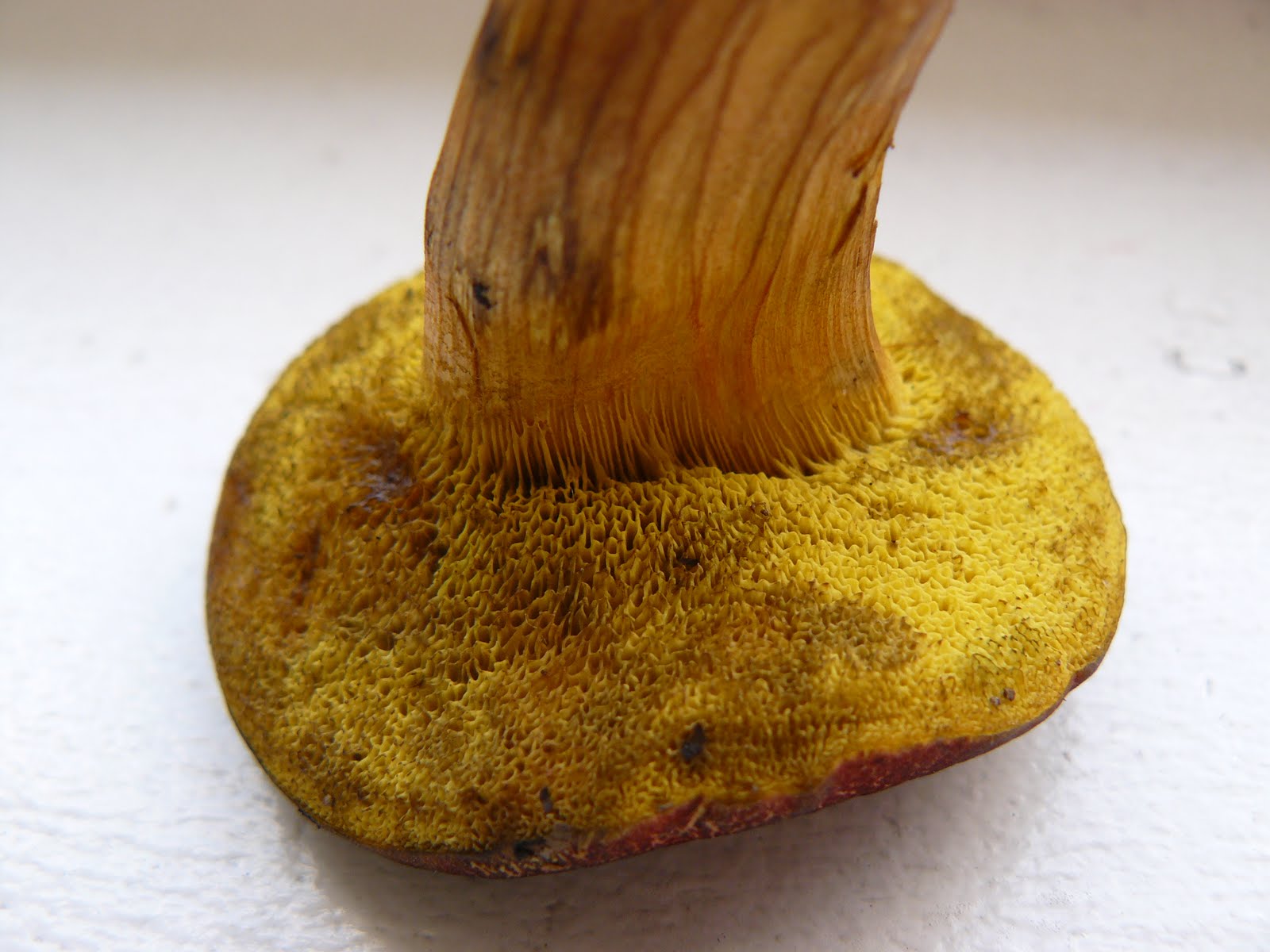
The weather has been very nice and fortunately we have had a lot of rain in the Rockville region over the last couple of weeks. Naturally, some of my friends are bragging about finding yellow chanterelles (C. cibarius), chicken (L. sulphureus), black staining polypores (M. giganteus) and a variety of boletes in the woods around Rockville. Today I went around the block (as usual) looking for mushrooms growing on lawns in the Rollins Park area. In a short 30 minutes walk I found a large variety of rusulas, Agaricus campestris, Amanita vaginata, Amanita flavorubens, Xerula megalospora, Phallus rubicundus, Tylopilus plumbeoviolaceous and a variety of boletes growing on grass and oak roots. One of the boletes I found looked specially nice (and potentially edible - did not stain when bruised and had a nice yellow pore surface without any tint of red or blue) and therefore I decided to face the challenge and try to identify it for a change.

So here it goes....

Date: 07/17/2011
Location: Rollins Park, Rockville, MD
Habitat: Solitary, growing on grass, under pine trees

Note that it does not stain
Measurements
Pileus diameter - 51 x 46 mm
Pileus height - 17 mm
Stipe lenght - 55 mm
Stipe diameter at apex - 9.6 x 23 mm
Stipe diameter at middle - 9.6 x 16.5 mm
Stipe diameter at base - 9.6 x 11.6 mm

Description
Pore surface depressing around stipe
Tubes are decurrent
Pileus - brown/red, dry, glabrous, cracked (specially near margin) and revealing light yellow flesh, smell is agreable, taste is mild and non-distinctive. Flesh is yellow and does not bruise.
Hymenium - tubes are bright yellow, depressed around the stipe, evenly distributed. Pores are angular and do not bruise. Tubes are around 6.8 mm long and decurrent (go down stipe 4 mm).
Stipe - central, tapered from base to apex, compressed, reticulated (bold brown reticulation)
Spore print - Not obtained

Impressions
This seems to be a Xerocomus spadiceus, also known as Boletus spadiceus Fries. This mushrooms is considered to be a good edible which fruits between July and September under conifers and mixed woods.

Some other possibilities which look very similar are B. illudens and B. subtomentosus. Based on the reference provided below, B. illudens' pileus is described as being pale brownish yellow and becoming yellow-brown to pinkish cinnamon and the pore surface as sometimes bruising weakly blue or blue green (the specimen's pileus had tones of red on the cuticle which do not seem to fit with the description and, in my opinion, the pore surface did not stain). The fact that the pore surface does not stain eliminates B. subtomentosus, which stains greenish blue. Furthermore, B. subtomentosus is described as having a pileus that is olive-ochre and that becomes olive-brown with age. I did not observe any tone of green on the cuticle of this specimen.

Last, depending on how you describe the stipe (i.e. “yellow, bright yellow to golden yellow or yellow orange” versus “pallid, pale yellowish, cinnamon to reddish brown”) a few other similar mushrooms could be considered. For this identification I considered the stipe to be pale yellowish…otherwise I would have to call this bolete Boletus sp.

References
North American Boletes: A Color Guide to Fleshy Pored Mushrooms, page 158.

Sunday, December 26, 2010

A corloful mushroom

It is not everyday that one encounters bright colored mushrooms. Indeed, most mushrooms I find are wheat-colored, gray, brown, white or other dull color. Therefore, a bright yellow, blue, purple or red thing in the forest is always a cool find and it always makes me think of the utility of color for fungi. From what I understand, a common explanation is that bright colors are used as a warning for predators (although this mushroom is not poisonous). I am not sure this explanation is applicable to macrofungi but I would love to know ;-). Whatever is the cause, this bright lemony-yellow solitary mushroom was popping out of the dry leaves about a month ago and, although I planned to write about it, for a long time I couldn't find a good time to do it.

So here it goes.

Date: 11/13/2010
Location: Scott's Run Nature Preserve, VA
Habitat: Solitary, growing on the ground, over dead leaves


Measurements
Pileus diameter - 24 mm
Pileus height - 7-8 mm
Stipe length - 42.5 mm
Stipe diameter at apex - 7.5 x 3.0 mm
Stipe diameter at middle - 7.0 x 3.0 mm
Stipe diameter at base - 5.7 x 3.0 mm

Description
Pileus - Convex, smooth, yellow-orange, shiny when fresh and dull after 1 hour, flesh is thin, yellow, cuticle is glabrous, odor is mild and non-distinctive, taste is mild and non-distinctive
Hymenium - Gilled, gills are adnexed, well spaced, pale yellow, undulated
Stipe - Central, equal, hollow, compressed, splitting, yellow-orange, surface is smooth, glabrous
Spore print - not obtained


Impressions
This is a specimen of Hygrocybe flavescens. The lemon-yellow color and compressed, splitting stipe are quite characteristic, making the identification very easy.

Reference
Roody, W.C. Mushrooms of West Virginia and the Central Appalachians. Pg 175.

Monday, November 15, 2010

Deadly Galerina

Galerina autumnalis
This mushroom is one that I believe it is worth knowing well, specially when one considers its toxicity and the deadly consequences of mistaking it for other mushrooms. Indeed, any amateur mycologist worth its salt should be capable of identifying at least this mushroom and a couple deadly Amanitas, as for instance the Death Cap (A. phalloides) and the Destroying Angel (A. ocreata, A. virosa and A. bisporigera)

The Deadly Galerina (Galerina autumnalis or Galerina marginata (Batsch) Kühner)  is a good example of why mushrooms picking (specially for the table) should be done with great respect. In spite of its small size, a single Galerina can kill an adult (or more). This little fungi contains a deadly toxin (alpha-amanitin) which is highly toxic to the liver and that can also affect kidneys and the brain. Reports of poisoning by G. autumnalis have been made since the beggining of the last century (Peck, 1912). Death occur around 5 days post ingestion if heroic measures (i.e. liver transplant) are not taken and those that survive have increased incidence of liver cancer. Although its identification is quite easy, once could possibly mistake it Psilocybe specie or for honey mushrooms.  Most often Galerinas are found growing on dead/rotten wood.
Note the white mycelium at the base.

Being a gregarious mushroom, one can always find multiple specimens on the same log and it's innocent appearance may even tempt some to taste it (please, don't!). To complicate things a bit, quite often Galerinas grow side by side with Honey Mushrooms (Armillaria gallica). For an example see Tom Volks website, where he has a cool photo showing both mushrooms growing on the same log.
Ring on the upper par of the stipe.
Galerinas are quite easy to identify. They are small (2.5-8 cm of length) wheat colored (Roody calls it yellow-brown to orange-brown). with a hemispheric to convex pileus (cap), which is viscid when moist, smooth and glabrous (bald). The hymenium has close, adnate (attached) gills that are more or less the same color as the cap cuticle. They have a central stipe (stem) that is equal (same diameter from bottom to top) and hollow. The stipe usually has a white ring on its upper part, that often is colored brown due to the falling spores. The stem has longitudinal lines (fibrillose streaking), which are dark brown, and it tends to be lighter at the top than at the base. Last, frequently the stipe is attached to decaying wood by a cottony white mycelium. If you happen to obtain a spore print, the color should be rusty brown.

Notes on this specimen
Date: 11/13/2010
Location: Scott's Run Nature Preserve, McLean, VA
Habitat: Gregarious, growing on rotten wood

Measurements
Pileus diameter: 17.3 mm
Pileus height: 8.3 mm
Stipe length: 40.5 mm
Stipe diameter at base: 3.0 mm
Stipe diameter at middle: 2.7 mm
Stipe diameter at apex: 2.7 mm

Description
Pileus: Convex, round, smooth, glabrous, yellow-brown, margin is dark brown, entire. Smell is non-distinctive.
Hymenium: Gills are adnate, pale brown.
Stipe: Central, equal, hollow, smooth with longitudinal streaking, light brown at top and dark brown at base, white mycelium at the point of attachment, brown ring on upper part of the stipe (10 mm from the pileus).
Spore print: Not obtained


References: Roody WC. Mushrooms of West Virginia and Central Appalachians. Pg 33.

Sunday, November 14, 2010

Last foray of the year

Unindentified mushroom
The winter is just around the corner and the mushroom season is probably almost over. Because  I haven't been going to forays very often (life is hectic when you have a two-year old daughter) I decided to join the last MAW foray of the year at Scott's Run Nature Preserve in McLean, VA. The group was composed of approximately 15 to 20 people and it was a beautiful day, with a perfect blue sky, and pleasant temperatures. 

Pear-shaped Puffball (Lycoperdon pyriforme)
Because it has not been raining a lot and because the temperatures at night are reaching freezing point, there weren't too many mushrooms around, specially in the areas far from the water where humidity is quite low. Furthermore, the leaves have already fallen, and by now most mushrooms are probably hidden under the a thick layer of beige material. In spite of that, a small variety of mushrooms were found, including some Blewitts (Clitocybe nuda), Fawn Mushrooms (Pluteus atricapillus), Deadly Galerinas (Galerina autumnalis), Pear-shaped puffballs (Lycoperdon pyriforme), a couple colorful and bright yellow colored Golden Waxy Cap (Hygocybe flavescens) and a variety of polypores, including the usual suspects: False Turkey Tail (Stereum ostrea), Turkey Tail (Trametes versicolor), Parchment fungus (Stereum complicatum), Thick Mazed Polypore (Daedalea quercina), Cinnabar-red Polypore (Pycnoporus cinnabarinus), one large specimen of what looked like a Stump Blossom (Polyporus berkeleyi) and a large number of Resinous Polypore (Ischnoderma resinosum). All in all, it was a fun foray and it gave me plenty of material to bring home for studying.

Resinous Polypore (Ischnoderma resinosum)
Since I don't expect to be going out on forays before the spring, I'll write about each of my findings over the next couple of weeks and post them in separate posts.

Thick Mazed Polypore (Daedalea quercina)

Saturday, September 4, 2010

A Giant Mushroom

About two weeks ago, while taking my daughter to the playground I spotted a cluster of giant mushrooms growing on a lawn near the park. Indeed, these mushrooms were so big that I initially thought they were something else. Because I did not have time to examine the specimen for a few days, I kept it in the fridge for almost a week (despite my wife's protest ;-).  Given the size of this fungi and the fact that it looked like a puff ball I was optimistic this one was going to be an edible and that it was going to feed me for a couple of days.


Description

Date
08/22/2010

Habitat
Gregarious (three specimens close to each other), growing on grass, under oak

Fruiting body
Pear shaped, very large, beige, dry, smooth, glabrous, wrinkled, leathery, approximately 110 mm wide at top and 140 mm of high. Odor is non-distinctive. When cut, it was possible to observe that the cuticle was quite thick and that the gleba was spongy and olive/beige.


Spore print
Not obtained

Impression
This is a specimen of Calvatia craniiformis (Schwein.) Fr., which is considered to be a very fine edible, when the gleba is pure white (not the case here). By the time I inspected it was already past its prime time and therefore was not edible anymore. I'm not sure why, but the Falcon Guide to North American Mushrooms recommends that they should be kept for one day at the refrigerator before eating. Because the genus Calvatia does not present any mushrooms with toxins and because the identification is quite easy I would think that this might be a good mushroom for beginners interested in picking edibles.